

The High Court has found former prime minister Najib Abdul Razak guilty on all four charges of abuse of power linked to the embezzlement of 1MDB funds.
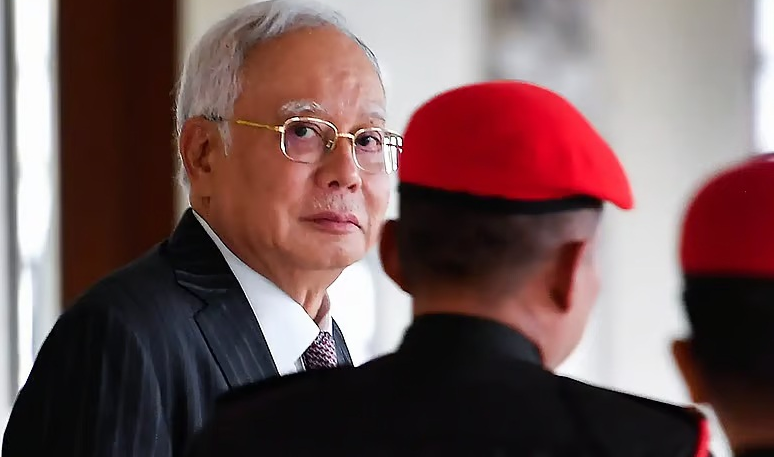 Delivering the verdict, presiding judge Collin Lawrence Sequerah said the prosecution had proven its case beyond a reasonable doubt. Najib was accused of using his positions as prime minister, finance minister and chairman of 1MDB’s board of advisers to secure financial benefits amounting to RM2.22 billion.
No country bumpkin
In his judgment, Sequerah rejected attempts to portray Najib as unaware of the wrongdoing. He described Najib as “no country bumpkin,” noting his superior intelligence, impeccable family and political pedigree, and extensive experience in administration.
The judge said Najib had lodged no reports with law enforcement despite claims that his signature appeared on forged documents. “Such an omission can only reasonably be constructed as an act of condonation,” Sequerah said. He added that Najib took drastic steps to protect his interests in 1MDB, including disbanding a special task force investigating deposits into his personal account in July 2015 and removing key figures such as former attorney-general Abdul Gani Patail and former MACC chief Abu Kassim Mohamed. Najib also attempted to persuade then Bank Negara governor Zeti Akhtar Aziz to issue a statement declaring “no wrongdoing” regarding funds in his accounts.
Unmistakeable bond with Jho Low
The court found Najib had a clear relationship with fugitive businessman Low Taek Jho, also known as Jho Low, with photographs showing them holidaying together. Sequerah said this, along with other evidence, supported the prosecution’s case.
Testimonies from former 1MDB executives Shahrol Azral Ibrahim Halmi, Mohd Hazem Abdul Rahman and Azmi Tahir confirmed Low acted as Najib’s unofficial adviser. Former chairman Mohd Bakke Salleh also testified that Low relayed Najib’s instructions and oversaw transactions.
The court accepted these testimonies despite the absence of Low, his proxy Terence Geh and Najib’s former aide Nik Faisal Ariff Kamil, who remain fugitives. “Authorities had made efforts to locate the trio, and the defence’s claim that the evidence was hearsay could not be accepted,” Sequerah said.
Arab donation letters – forgeries
Najib’s defence that the funds were Arab donations was dismissed as “not meritorious.” Sequerah ruled that four letters Najib claimed were from Saudi Arabia were forgeries, as originals were never produced.
Najib testified that King Abdullah had pledged financial support in 2010, with letters between 2011 and 2014 promising donations totalling billions in US dollars and British pounds. These letters were addressed to Najib’s private residence and bore the name Saud Abdulaziz bin Majid Al Saud.
“The accused was consistent in his belief that he was receiving funds from Saudi Arabia,” Sequerah said, but noted there was no verification of the source. “There was no evidence of any formal acknowledgement by the government or any political party to the purported donor, and for that matter, by the accused himself.”
The judge said it was inconceivable that no proper accounting was conducted despite such colossal sums being deposited. “It defies reasonable belief that a prime minister of the ruling political party would not have accounting records kept by an organisation supposedly the beneficiary of these sums of money,” he added.
The charges
Najib was charged in 2018 with four counts of abuse of power and 21 counts of money laundering. The trial began in 2019.
He allegedly used his position to obtain gratification totalling RM2.3 billion of 1MDB funds between February 2011 and December 2014 at AmIslamic Bank Berhad in Kuala Lumpur. The money laundering charges relate to transactions at the same bank between March and August 2013.